Marcel Proust on Memory: Why a Taste Can Return a Whole Childhood
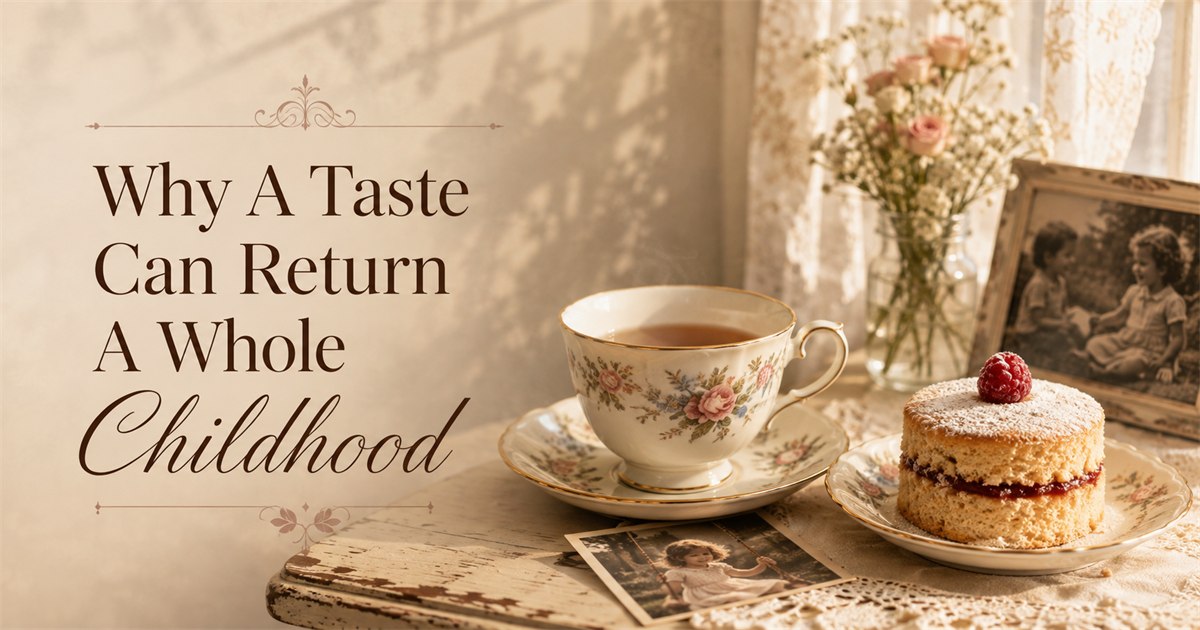
Almost everyone has had the experience, even if they have never read a word of Proust. A smell in a corridor, and you are eight years old. A particular song, and a room you have not thought about in twenty years is suddenly around you.
Then it fades, and you cannot get it back by trying.
Proust built a seven volume novel out of that moment. What he noticed about memory turns out to matter enormously for grief, for gratitude, and for anyone who has wondered why prayer sometimes lands and sometimes does not.
Who Marcel Proust was
Involuntary memory is a recollection that arrives without being summoned, usually triggered by a sensory cue such as a taste or a smell. It differs from ordinary recall because it cannot be produced on demand. When it comes, it tends to return the past with a vividness that deliberate remembering rarely achieves.
Marcel Proust was a French novelist who lived from 1871 to 1922. He suffered from severe asthma for most of his life and spent his final years largely indoors, writing in a room lined with cork to keep the noise out.
His work is one enormous novel, In Search of Lost Time, published in seven volumes between 1913 and 1927. He did not live to see the last of them appear.
The novel is often described as being about French society. It is more accurately about time, and about what happens to a life that is being continuously lost.
What actually happens in the madeleine scene
The scene everyone half remembers is more interesting than its reputation.
The narrator, an adult, is unhappy and cold. His mother offers him tea and a small shell shaped cake, a madeleine. He dips the cake in the tea and raises it to his lips.
What arrives first is not a memory. It is an overwhelming joy, with no content attached and no explanation available.
He tries a second mouthful, then a third, and the sensation weakens each time. This is the detail that gets left out of the popular version, and it is the most important part.
Only after he stops trying does the memory surface. His aunt at Combray, on Sunday mornings, giving him a madeleine dipped in her tea, and then the whole town, the streets, the gardens, all of it rising out of a cup.
Proust's conclusion is quietly devastating. The past is not stored where the intellect can reach it. It is held somewhere outside our control, and whether we ever recover it is largely a matter of chance.
Voluntary memory, and why it gives you so little
Proust distinguished sharply between two kinds of remembering.
Voluntary memory is what you use when you deliberately think back. It is reliable, it is available on request, and it is oddly flat.
Try it now with a childhood home. You can list the rooms, the colour of a door, where the furniture stood. What you almost certainly cannot do is feel it.
That is voluntary memory doing exactly what it does. It returns information about the past rather than the past itself.
Involuntary memory returns the thing. It cannot be requested, it lasts seconds, and it does what years of deliberate reminiscence fail to do.
Why taste and smell do this
The two senses that trigger these episodes most reliably are the two we have the least language for.
You can describe a face in detail. Try describing a smell without naming the thing that produces it, and you will run out of words almost immediately.
That poverty of language may be exactly why smell and taste keep their charge. A memory you have described a hundred times becomes the description. A memory that was never put into words stays unworn.
This has a practical implication that most people discover by accident. The photographs of a person you have lost gradually stop working, while their coat, found at the back of a wardrobe, still functions perfectly.
Where Proust and Jung meet
Proust was a novelist and Jung was a psychiatrist, and they were circling the same discovery from opposite directions.
Both concluded that the most significant material in a person is not under conscious control. Jung called what surfaces from below the unconscious. Proust simply described it arriving with a cup of tea.
Both also noticed that trying harder makes it worse. The narrator's third mouthful is fainter than his first, and Jung's patients did not produce meaningful dreams by demanding them.
And both treated the material as something to receive rather than to manufacture. Our article on Jung and Christianity covers what he built on that observation, and where it needs handling with care.
The difference is what they did next. Jung wanted to integrate what surfaced. Proust wanted to write it down before it went.
Augustine got there first
Fifteen centuries before either of them, Augustine devoted a long section of his Confessions to memory, and he found it genuinely disturbing.
He describes memory as vast halls and fields, full of things he did not put there deliberately and cannot summon at will. He is astonished that he cannot reach the bottom of himself.
His conclusion goes somewhere neither Proust nor Jung followed. If he contains depths he cannot survey, then he is not the ground of his own being, and the search leads outward to God rather than further inward.
That is the fork in the road. All three men look into the same abyss of memory. Augustine is the one who concludes that it points beyond the person who contains it.
What Scripture does with remembering
Once you notice how weak deliberate memory is, the biblical emphasis on remembering starts to look less like piety and more like engineering.
Israel is told repeatedly to remember that they were slaves in Egypt. After crossing the Jordan, they are told to pile up twelve stones so that children will ask what they mean.
Notice the method. The command is not to think harder. It is to build something physical that will ambush a future generation with a question.
At the last supper, the instruction is the same shape. Do this in remembrance of me, attached to bread and wine rather than to a doctrine.
Scripture consistently ties memory to objects, meals, stones and repeated actions. It behaves as though the writers already knew that taste and touch hold what argument cannot.
What this means for grief and prayer
Two practical consequences follow, and both come up constantly among people who are grieving.
The first is that ambushes are not setbacks. When a smell in a shop doubles you over eleven months after a funeral, nothing has gone wrong. That is involuntary memory doing what it does.
The second is that you cannot schedule those moments, and trying tends to produce the flat version. This is worth knowing before an anniversary, when people often expect to feel something specific on demand.
What you can do is leave the triggers accessible. Keep the coat, cook the meal, play the record, walk the route.
The same applies to prayer. Dry, deliberate prayer is not failed prayer, it is voluntary memory's equivalent, and it is often what faithfulness looks like on ordinary days. Our piece on where God is when you are grieving deals with that silence at greater length.
The vivid moments arrive unpredictably and cannot be manufactured. Both Proust and every honest person of prayer eventually arrive at the same practice, which is to keep showing up and let the rest be given.
Common questions
What is the madeleine moment?
It is the scene in Swann's Way where the narrator tastes a cake dipped in tea and his childhood at Combray returns entire. It has become shorthand for any sensory trigger that reopens the past.
Do I have to read all seven volumes?
No. The opening section of Swann's Way, which contains the madeleine, stands perfectly well on its own and is where most readers start.
Why do smells trigger memories so strongly?
Partly because we have almost no vocabulary for them. Memories we have never translated into words stay closer to their original state than the ones we have retold many times.
Is involuntary memory the same as a flashback?
No. Involuntary memory is generally welcome, even when painful. Traumatic flashbacks are intrusive, distressing and worth taking to a professional rather than treating as a literary experience.
Was Proust a religious writer?
Not in any conventional sense. He was, however, unusually serious about time, loss and what redeems a life, which is why readers of faith keep finding him worth the effort.
Can I make an involuntary memory happen?
No, and the attempt reliably weakens it. What you can do is stay near the triggers, by keeping the objects, cooking the food and walking the old routes, then leave the rest alone.
Why do old photographs stop working?
Because you have looked at them too often. A picture you have studied a hundred times becomes the memory, replacing the original with a version you have worn smooth.