Is Depression a Sin? What Faith and Psychology Both Get Right
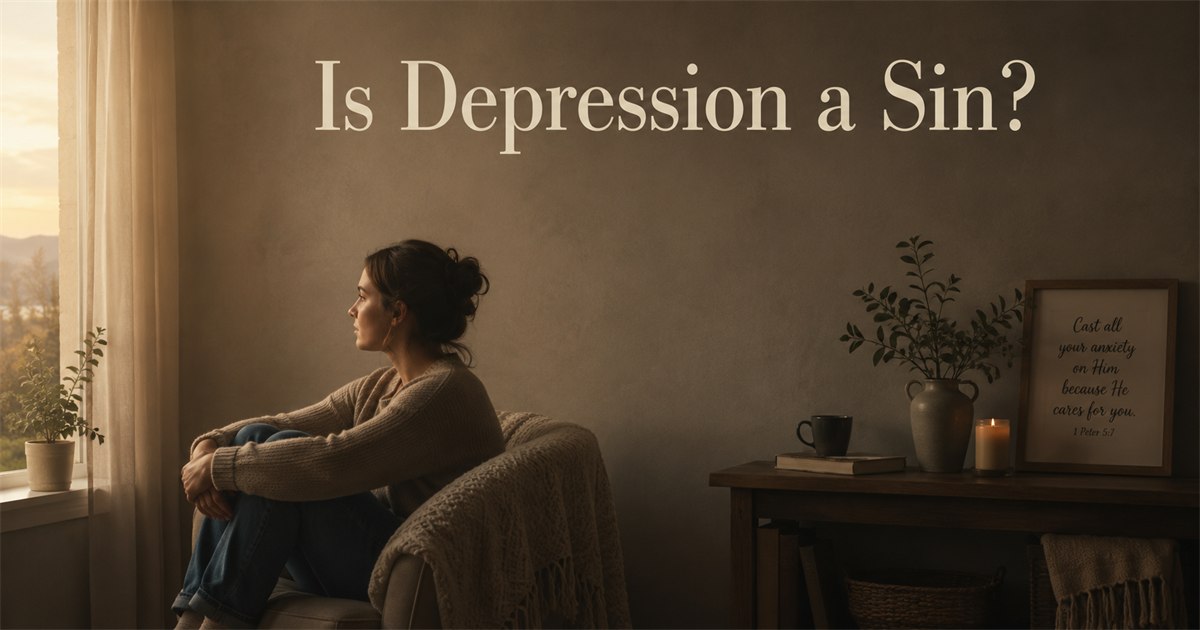
This question gets asked quietly. People type it into a search bar at night rather than raise it in a small group, because asking it out loud feels like admitting to something.
The short answer is no. Depression is not a sin, not a punishment, and not evidence that your faith has failed.
The longer answer is worth reading, because the reasons people believe otherwise are specific, and they can be dismantled one at a time.
What depression actually is
Depression is a clinical condition that lowers mood, energy and interest for weeks or longer. It affects sleep, appetite, concentration and the ability to feel pleasure. Unlike ordinary sadness, it does not lift when circumstances improve, and it responds to treatment rather than to effort alone.
That last point is the one that gets missed. Sadness has a cause and an end. Depression frequently has neither, which is exactly what makes it so disorienting.
People with depression often say the strangest part is having nothing to be sad about and feeling that way regardless. That is not ingratitude. It is a symptom.
Why the question gets asked at all
Three ideas feed this question, and all three are worth naming directly.
The first is the assumption that joy is commanded, so its absence must be disobedience. The second is that depression looks from the outside like laziness or self-absorption.
The third is the most damaging: someone the person trusted told them so. A pastor, a parent or a friend suggested that if they prayed properly, this would lift.
None of these hold up. But they land hard on someone already convinced they are failing.
Scripture is full of people in deep darkness
The Bible does not present faithful people as consistently cheerful. It presents them as human.
Elijah asked God to take his life. He had just won a decisive public victory, and days later he was alone in the wilderness with nothing left.
Job cursed the day he was born. Jeremiah, in Lamentations, describes being walled in, weighed down and left in darkness.
Psalm 42 asks the question directly: why, my soul, are you downcast? The psalmist speaks to his own condition without pretending it away.
Psalm 88 is the starkest of all. It is the one psalm that does not resolve, and its final line says that darkness is the writer's closest friend.
That psalm was kept. It was collected, preserved and sung, which tells you something about how Scripture regards the person who cannot find the light.
What the Bible calls sin, and what it does not
Sin in Scripture is consistently a matter of will and action. It is something chosen, done or refused.
Depression is none of those things. Nobody selects it, and it does not respond to being told to stop.
Isaiah 53 describes the Messiah as a man of sorrows, familiar with suffering. Sorrow itself cannot be sinful if it appears in that description.
The confusion often comes from mixing up cause and category. Sin can produce misery, and misery is not therefore sin.
Does sin ever play a part?
Honesty requires holding this carefully, because the truthful answer is not a flat no in every case.
Sometimes low mood follows something real. Unresolved guilt, a betrayal you committed, a habit that is quietly wrecking your sleep and relationships.
That is worth examining, and Scripture would call the examination healthy. But it is a specific situation with a specific cause, not an explanation for depression generally.
The test is straightforward. If there is a concrete wrong to put right, put it right and see what changes. If there is nothing to find, the search itself becomes another form of self-punishment.
This is where the difference between shame and conviction matters enormously. Conviction points at something you did. Shame points at what you are, and it never runs out of material.
What psychology gets right
Clinical understanding brought three things that pure spiritual explanations could not.
It identified physical contributors. Thyroid disorders, chronic pain, sleep disruption, postnatal changes and certain medications all produce depressive symptoms directly.
It produced treatments that work. Talking therapies and medication both have measurable effects, and for many people a combination works better than either alone.
It also gave people permission to describe symptoms accurately. Naming a condition removes the need to invent a moral explanation for it.
What faith holds that a clinic cannot
Treatment is not the whole picture either, and it is fair to say so.
Therapy can reduce symptoms without answering the question underneath them. Depression frequently attacks a person's sense of worth and meaning, and those are not medical categories.
Faith speaks directly there. It says your value was never a function of your productivity, your mood or your usefulness this week.
Church, at its best, also supplies something a fifty minute appointment cannot: people who notice you are missing, and who turn up with food.
The two are not competitors. One treats the condition and the other addresses the person carrying it.
What to do if this describes you now
A few practical steps, in the order most people find manageable.
- Tell one person. Not the whole church, one person who will not flinch.
- Book a doctor's appointment and describe the symptoms plainly, including how long they have lasted.
- Protect sleep and food before anything else. Both make every other symptom worse when they slip.
- Lower the spiritual expectations temporarily. A single verse counts. Sitting in silence counts.
- Let other people pray on your behalf during the stretches when you cannot.
If you are having thoughts of ending your life, treat that as urgent rather than shameful. In the United States you can call or text 988 for the Suicide and Crisis Lifeline. Elsewhere, contact your local emergency number or go to your nearest emergency department.
Grief and depression overlap and are often confused, particularly after a loss. Our piece on where God is when you are grieving deals with that silence specifically.
Telling depression apart from ordinary sadness
The two get confused constantly, and the distinction changes what you should do next.
| Sadness | Depression | |
|---|---|---|
| Cause | Usually identifiable | Often none you can name |
| Duration | Days, lifting gradually | Weeks or months, without lifting |
| Good moments | Still possible | Pleasure itself becomes hard to feel |
| Body | Largely unaffected | Sleep, appetite and energy all disrupted |
| Self-image | Intact | Turns against you |
| Response to good news | Lifts the mood | Barely registers |
The final row is the one people find most clarifying. Sadness responds to circumstances improving, and depression frequently does not.
If several rows in the right-hand column describe your last month, that is worth a doctor's appointment rather than another attempt to pray harder.
What to say to someone who believes it is their fault
Many people arrive at this question having already been told the opposite of everything above, often by someone they trusted.
Arguing theology with them rarely helps while they are unwell. Depression is very good at absorbing arguments and turning them into further evidence of failure.
What lands better is smaller. Tell them you do not think this is their fault, tell them you are not going anywhere, and then keep turning up.
Practical help does more than reassurance. A meal, a lift to an appointment, an hour of childcare, all of it reduces the load that is currently unbearable.
If they raise the spiritual question themselves, one honest sentence is enough. Elijah was fed and allowed to sleep before God said anything to him at all.
Common questions
Does depression mean I have weak faith?
No. Faith is not measured by mood. Some of the most faithful people in Scripture recorded their darkest periods in writing, and those records were preserved rather than edited out.
Should a Christian take antidepressants?
That is a medical decision between you and your doctor. Nothing in Scripture forbids treatment, and taking medication is not a statement about your trust in God.
Why does God not just heal it?
Nobody can answer that honestly for your situation. What can be said is that healing often arrives through ordinary means, including doctors, medication, rest and people who stay.
How do I support someone who is depressed?
Stay in contact, keep the invitations coming without pressure, and resist the urge to supply a reason. Practical help usually lands better than advice.
Can prayer alone cure depression?
Prayer matters and it is not a treatment plan. Depression has physical components that respond to medical care, and treating it does not mean you prayed insufficiently.
Someone at my church told me to stop taking my medication. What now?
Do not stop, and speak to your doctor before changing anything. Stopping antidepressants suddenly can be genuinely dangerous, and no one outside your medical team is in a position to make that call.
Why do I feel worse at church than anywhere else?
Because the gap between how you feel and how you are expected to look is widest there. Telling one trusted person usually closes that gap faster than trying harder to appear well.